
Hundreds of people are desperately searching for missing family members and friends outside hospitals in Nepal, as devastating flash floods have killed at least 270 people and left 826, including 476 foreigners, reported missing.

Two men, Kabir Maharjan and Sanjay Sah, have been rescued alive from a tunnel at the Trishuli 3A hydropower project in central Nepal, nine days after a devastating flash flood tore through the Trishuli River corridor.

Five-year-old Ishara Tamang lies in a hospital bed in Kathmandu, injured and separated from her family, after surviving the flash floods that devastated Rasuwa district on the Nepal-Tibet border.She was rescued from the floodwaters in Khalte, a village in Rasuwa, after being trapped in a net.

Flash floods in Trishuli, Nuwakot district, Nepal, left homes buried in mud, survivors stranded, and rescue teams working tirelessly to recover victims. Drone views reveal the scale of devastation, with damaged houses, debris, and sacred sites submerged. Rescue teams, security forces, and government officials mobilized swiftly, while survivors await relief amid blocked roads and destroyed property.

Nepal is grappling with a deepening flood crisis as the death toll from devastating flash floods in Rasuwa and surrounding districts has tragically risen to 538, with authorities now warning of a fresh flood threat and initiating evacuations.

One week ago, on August 26, 2026, deadly flash floods and mudslides devasted Nepal. Powerful floodwaters and landslides tore through river towns, leaving behind widespread destruction and grief. Rescue efforts across the affected districts continue even as hopes fade of finding survivors.

Rescue teams led by the Nepal army continue search operations to locate survivors from the August 26 disaster. 4,873 people remain missing.

Images emerging from Nepal show the extent of destruction caused by the massive flash flood that swept through the Bhote Koshi and Trishuli river corridors, with houses, roads and bridges destroyed and large areas covered with mud, rocks and debris.

Sanjay Sah, a 30-year-old employee, was rescued from a tunnel at the Trishuli 3A hydropower project in Nepal after nine days. He attributed his survival to chanting 'Hare Krishna' and was miraculously rescued on Krishna Janmashtami. Another worker, Kabir Maharjan, was also rescued but required further medical treatment. Sah, a foreman, stayed behind to ensure others' safety during the initial disaster.

"Everything was here before, but now there is nothing left," said Nayan Tiwari, one of many residents returning to flood-hit Galchhi in central Nepal to recover whatever belongings remain and to restore homes that once held their everyday lives.

The death toll in the massive flash floods in Nepal on Thursday rose to 270, as authorities in Nepal race against time to find thousands of missing people, including 288 Indian tourists, in one of the country's worst disasters in recent years.

The rising water level in the Narayani-Gandak river following heavy rainfall in Nepal has increased the flood threat in villages along the river in Maharajganj district, officials said on Sunday.

Devastating Bhote Koshi floods in Nepal have led to a surge in recovered bodies, overwhelming morgues across several districts. Authorities are setting up temporary facilities and preparing for the management of unidentified remains as identification efforts continue.

Nepal is grappling with one of its worst disasters in recent years as massive flash floods, triggered by an ice avalanche, have claimed 270 lives and left thousands missing across multiple districts, prompting urgent rescue and relief operations.

The water levels in the Bhotekoshi River rose again on Sunday, days after a devastating flash flood struck Nepal, authorities warned, urging residents and rescue personnel in flood-hit districts to remain alert.

Nepal is reeling from devastating flash floods that have claimed over 600 lives and left more than 2,400 people missing. Rescuers are battling difficult conditions, including intermittent rainfall, to find survivors, while families desperately search for loved ones among lists of the injured and deceased. The widespread destruction has left towns and villages buried under mud, with infrastructure severely damaged.

Flash floods in Nepal, triggered by an ice and rock collapse near the Nepal-Tibet border, have devastated hydropower projects, leaving hundreds of workers stranded. Survivors recount terrifying escapes from rising floodwaters and tunnels, while international teams assist in ongoing rescue operations to locate those still missing.

A massive flash flood originating in Tibet has devastated central Nepal, killing 17 people and leaving nearly 500 missing, including 105 Indians. The deluge, caused by a rock slide near the Nepal-Tibet border, swept through districts, washing away bridges and severely damaging at least a dozen hydropower projects.

On Wednesday, August 26, 2026, devastating flash floods in Nepal's Rasuwa district, bordering Tibet, left 105 Indian tourists among nearly 400 people missing.

Following devastating floods in Nepal, families are facing immense challenges in identifying their missing relatives. Hospitals are overwhelmed with unidentified bodies, leading to disputed claims and a reliance on DNA testing, which can take months. Personal belongings and distinctive features are sometimes used, but forensic evidence is often the only conclusive method.

The death toll from flash floods in central Nepal has surged to 734, with nearly 2,500 people still missing. India has intensified its rescue and relief efforts, sending additional aid, technical teams, and forensic experts, while also working to locate and rescue over 275 missing Indian nationals.

Extraordinary accounts of survival are emerging from Nepal's devastating flash floods, including a 97-year-old woman rescued from rubble and individuals who fled collapsing settlements, spending nights stranded in forests before rescue.

Nepali security forces have intensified search and rescue operations across the flood-hit areas, using helicopters and ground teams to evacuate survivors and search through mud and debris.
The operation remains challenging as destroyed roads and bridges have cut off several remote communities, while hundreds of people are still missing.

Devastating flash floods in Nepal's Bhote Koshi River, triggered by a glacier or ice rock collapse, have resulted in 175 recovered bodies and hundreds missing, including tourists. India has promptly responded by providing 10 tons of humanitarian aid and medical supplies, with Prime Minister Narendra Modi conveying condolences and assuring full support to Nepal.

Massive flash floods in Nepal, triggered by an ice-rock avalanche, have devastated the border town of Timure and other central districts, leaving a rising death toll and hundreds missing. The disaster, described by witnesses as feeling like an earthquake, has claimed entire families and caused widespread destruction to infrastructure. Rescue efforts are underway, with a significant number of missing individuals identified as tourists, including nearly 300 Indian nationals.

Australian tunnel expert Arnold Dix, known for the Silkyara tunnel rescue, is now assisting in a complex search-and-rescue operation in Nepal following devastating floods. He is applying lessons learned from the Silkyara operation, particularly the principle of "never confuse unlikely with impossible," as he works with Indian and Nepali teams to locate people potentially trapped in the Chilime hydropower tunnel and other sites.

Following devastating floods in Nepal, Kathmandu has initiated mass burials for unidentified victims as morgues have exceeded capacity. Security forces are burying bodies with markers and collecting DNA samples for future identification. The government has amended the Unidentified and Unclaimed Bodies Management Guidelines, 2021, to facilitate the management of disaster victims, including provisions for autopsies, DNA collection, and temporary burial with identification markers.

The death toll from devastating flash floods in Nepal has surged to 1,050, with nearly 4,000 people, including foreigners and security personnel, still missing. Rescuers are struggling with intermittent rainfall, rising river levels, and difficult terrain, while expert teams from India and China assist in operations, particularly at hydropower project sites where many workers are believed to be trapped in tunnels.

With the death toll crossing 900 and nearly 4,000 people still missing, the trauma of loss, displacement and uncertainty is settling in among thousands of survivors, prompting the government to step up its mental health response.

At least 27 Indian pilgrims, all from Maharashtra, who arrived in Nepal for a 10-day tour were killed and 16 others injured after their bus veered off the highway and fell into a fast-flowing river in central Nepal on Friday.
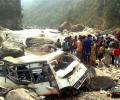
An Indian woman, Mamata Devi Thakur, died in the accident, police said.

Widening 'Operation Maitri', the Indian Army on Monday moved its rescue mission outside Nepal's capital into the epicentre of the devastating earthquake.

Massive rescue and relief efforts were mounted by India and other neighbours in Nepal, as two powerful aftershocks today rattled the country, adding to the misery of Saturday's devastation in which the casualties soared to 2,400 people dead and over 6000 others injured.

Racing against time, rescuers on Sunday waded through tonnes of rubble of flattened homes and buildings in Nepal to look for survivors of the earthquake.
